










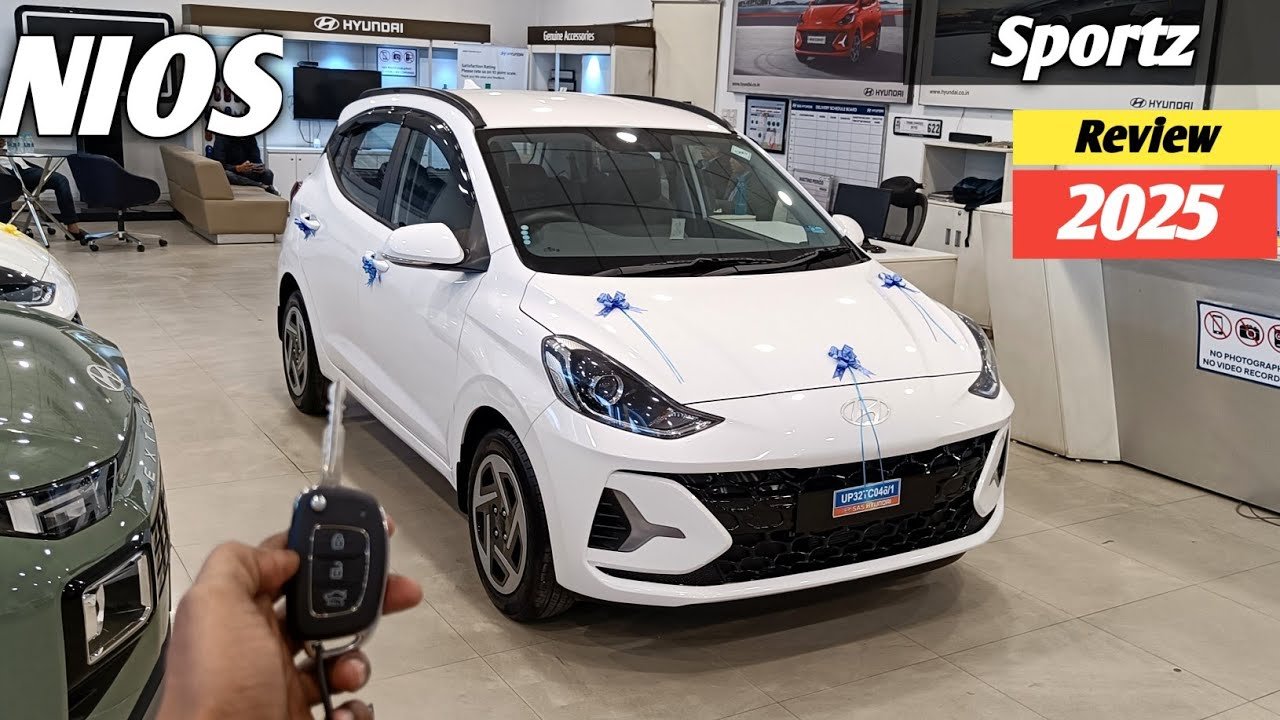
Hyundai Grand Nios Sport CNG: A Detailed Look
The Hyundai Grand Nios is a popular and feature-loaded hatchback. This article offers a comprehensive review of its Sport CNG variant, highlighting what makes it a great value-for-money choice in its segment.
Key Highlights and Pricing
The Hyundai Grand Nios starts with its base Era model, priced at ₹5,98,000 ex-showroom. The Sport CNG variant, a popular choice, has an on-road price of about ₹9,87,000 in Lucknow, including accessories.
Key features like six airbags, projector headlamps, a touchscreen display, and a reverse parking camera are offered as standard. The Grand Nios comes in four main variants: Era, Magna, Sport, and Asta.
Exterior Design and Features
Front View
The front of the Grand Nios features a Hyundai logo. It has a glossy black lower grille. The projector automatic headlamps provide clear lighting, and they also include integrated indicators. Daytime Running Lights (DRLs) are designed with a unique tri-design pattern. The car offers a ground clearance of about 165 to 170 mm. It also includes a dual wiper and washer system. While a plain roof is standard, a dual-tone roof option is available, which adds a black roof and alloy wheels to the Sport dual-tone variant.
Side Profile
The Grand Nios comes with a warranty of 3 years or 100,000 kilometers, which can be extended for an extra charge. It rides on 15-inch stylish wheels with four nuts and a Hyundai logo. The front wheels are equipped with disc brakes. The tires are 175/60 R15 radial tires. The side mirrors (ORVMs) are electrically adjustable and foldable, and they include integrated indicators. The A-pillar matches the body color, while the B-pillar has a black finish. Door handles are body-colored, and black roof rails are present. A CNG sticker is also visible on the side.
Rear Design
At the back, the Grand Nios features connected taillights, though only a part of them lights up. The Hyundai logo is in the center, alongside the “Nios” badge. A reverse parking camera is integrated into the rear. You will also find a “Grand i10” badge on the side. Other features include a rear defogger, a high mount stop lamp, and a shark fin antenna. The LED backlights are standard. Indicators and reverse lights are located below the main lights. The body-colored bumper houses two reverse parking sensors and reflectors. A black cladding is also visible at the bottom of the rear bumper.
Dimensions and Color Options
The Hyundai Grand Nios measures 3815 mm in length, 1680 mm in width, and 1520 mm in height. It has a wheelbase of 2450 mm. The car is available in a variety of colors, including White (a top-selling option), Grey, Spark Green, Red, and Silver.
Boot Space and Fuel Capacity
The standard boot space of the Grand Nios is approximately 260 liters. However, in the CNG variant, this space is reduced by two 3kg CNG cylinders. Despite the cylinders, there is still usable space for luggage above them. A parcel tray is not included but can be purchased as an accessory. Instead of a spare wheel, a puncture repair kit (tire mobility kit with inflator and liquid) is provided. The rear seats offer 100% folding capability. The petrol fuel tank has a capacity of 37 liters, while the CNG tank can hold about 8 to 9 kg of gas, depending on the pump pressure.
Interior Comfort and Technology
Cabin Overview
The interior features a dual-tone dashboard design. Six airbags are standard from the base model, ensuring enhanced safety. The car includes a touchscreen display and blue lighting near the footstep area.
Rear Seat Experience
The rear door trim also has a dual-tone finish, with power window controls, speakers, and bottle holders. The seats are made of fabric, though covers are often added as accessories. Rear passengers benefit from good legroom, knee room, and decent thigh support. The headrests are adjustable, and three points are provided for seatbelts. There is no armrest in the rear. AC vents are present, along with a 12V charging outlet, which is a useful feature not found in some competing models.
Driver’s Cockpit
The driver’s door includes a child lock feature. The car uses a flip remote central locking key with buttons for lock, unlock, and boot unlock, featuring the Hyundai logo. A normal physical key is also provided. The driver’s door trim is similar to the rear, with controls for all four power windows, central locking, and ORVM adjustment and folding. The fabric seats (with accessory covers) feature airbag branding, height adjustment, and recline functions. Controls for opening the fuel cap and bonnet are located near the driver’s seat. Other driver-focused features include a traction control button, a switch to toggle between petrol and CNG modes, and a headlamp level adjuster.
Instrument Cluster
The instrument cluster is analog, showing the RPM meter on the left and the speedometer (marked up to 220 km/h) on the right. It also displays CNG and petrol fuel bars. The Multi-Information Display (MID) screen in the center provides various details like trip information, average mileage, range, audio details, Tire Pressure Monitoring System (TPMS), door light, service interval, language settings, and reset options, all controllable from the steering wheel.
Center Console
The center console features an 8-inch touchscreen with connectivity options like Android Auto, Apple CarPlay, USB, and Aux. It also serves as the display for the reverse parking camera, showing clear visuals when reversing. Buttons for changing tracks and controlling radio/media are easily accessible. Below the screen are the AC vents and manual AC controls, which include fan speed, temperature, and airflow adjustment. There’s a 12V charging outlet, along with Type A and Type C USB ports. Storage space is available for items like phones. The Sport Dual Tone variant offers additional features such as alloy wheels and a wireless charging pad. The car comes with a 5-speed manual transmission, with an automatic option also available. Two glass holders and a manual handbrake are located in the center. The glove box offers storage but is not cooled. Other interior features include a manually adjustable IRVM, a microphone, a ticket holder on the driver’s sun visor, and a vanity mirror on the passenger’s side.
Engine Performance and Mileage
The Hyundai Grand Nios is powered by a 1.2-liter, 4-cylinder petrol engine. It does not have insulation under the bonnet. In petrol mode, this engine produces 82 bhp of power and 113-114 Nm of torque. When running on CNG, the power output is slightly lower at 68 bhp and 95 Nm of torque. The CNG variant delivers an impressive mileage of 28 to 30 km/kg, making it a very economical hatchback.
Safety Features
The Grand Nios is equipped with a strong suite of safety features to protect its occupants. These include Anti-lock Braking System (ABS) with Electronic Brakeforce Distribution (EBD), six airbags, reverse parking sensors, a reverse parking camera, a speed alert system, seat belt warning for all passengers, engine immobilizer, traction control, Electronic Stability Program (ESP), and a Tire Pressure Monitoring System (TPMS).
Conclusion
The Hyundai Grand Nios Sport CNG is a well-rounded and feature-packed hatchback. It offers a great combination of style, comfort, technology, and fuel efficiency, making it an excellent choice for daily commuting and city driving.